


The 6th Annual Massachusetts Food Access Report

Hunger on the Rise

Download the One-Pager

Demand Outpaces Response

In Massachusetts, the rate of food insecurity has more than doubled since 2019, driven by rising costs, ongoing economic instability, and federal policy changes.
Even as participation in food and nutrition assistance programs reached record levels among those with food insecurity, many households report it is not enough—they must often stack multiple programs and make impossible tradeoffs between food, housing, and healthcare.The widening gap between the need and availability of support services reflects structural underinvestment in the systems meant to prevent hunger.

40%

The State of Food Insecurity

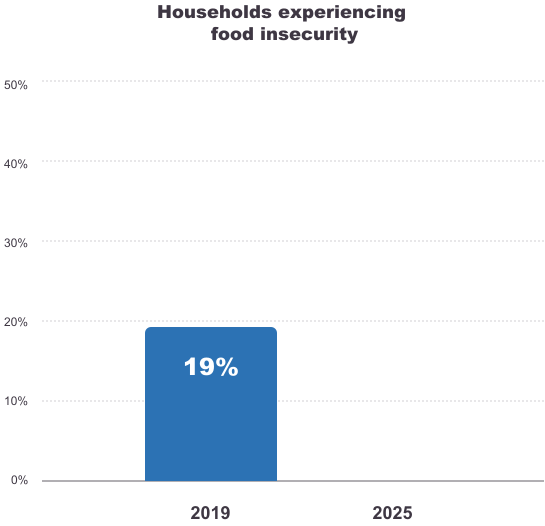
The number of Massachusetts households experiencing food insecurity has increased substantially, rising from 19% in 2019 to 40% in 2025. During the same period, rates of very low food security (the most severe form of food insecurity with hunger) have more than quadrupled, growing from 6% in 2019 to 25% in 2025. These trends have hit communities throughout Massachusetts—but not equally.

Understand the Landscape

Centering Households Experiencing Hunger

In 2025, our data shows that households experiencing food insecurity are using food and nutrition assistance programs at a six-year high.

92%

of SNAP participants say the benefits helped their household

75%

of families receiving SNAP still need additional food support

56%

of households rely on community food programs, such as food pantries, mobile markets, or community meals

32%

of households using MassHealth received nutrition services such as home delivered meals, food boxes, or gift cards, improving health and lowering costs

80%

of households with children used free school and/or summer meal programs

86%

of households using WIC felt benefits helped

Get the Facts

Financial and Healthcare Costs

When people have trouble accessing food, their resource challenges rarely stop there, creating income inequality and compounding healthcare issues at a large scale. We found that up to $1.6 billion of healthcare spending for emergency room and inpatient hospitalization for people enrolled in MassHealth may be related to food insecurity.

Learn More about the Costs

Voices of Hunger

Statistics only tell part of the story, which is why we asked respondents to share their perspectives on how to better invest in community food access. Their stories emphasized the struggle to afford food and other basic needs, and the importance of making food and nutrition assistance programs more accessible and responsive to the community’s needs.  

Read Their Stories

Summary and Recommendations

To improve the widening gap between rising food insecurity and available resources, we must strengthen policies and programs and address the root causes of hunger.

Take Action

In Appreciation

The authors are especially grateful to the people of Massachusetts who shared their experiences of hunger through the 2025 survey that informs this report.

We thank our many state and community partners devoted to this work, and members of The Greater Boston Food Bank’s Health and Research Council and the INNOVATE lab at Mass General Brigham for Children for their collaboration and shared commitment to ending hunger.

Authors

Jatnna Soto, MD (MGB, GBFB)

Anisha Gundewar, MD, MPH (MGB, GBFB)

Man Luo, MPH (MGB)

Meghan Perkins, MPH (MGB)

Catherine Lynn, MPA

Michele Fronk Schuckel, MBA, MPH, BSN, RN (GBFB)

Cheryl Schondek, MBA (GBFB)

Kathryn Alexander (GBFB)

Daniel Taitelbaum (GBFB)

Kate Adams, MPH (GBFB)

Lauren Fiechtner, MD, MPH (MGB, GBFB)

Suggested Citation

Soto J., Gundewar A., Luo M., Perkins M., Lynn C., Fronk Schuckel M., Schondek C., Alexander K., Taitelbaum D., Adams K., Fiechtner L. Massachusetts Food Access Report: Hunger on the Rise. The Greater Boston Food Bank. Published 2026.