

Demand Outpaces Response
Our data found that charitable food and nutrition assistance programs, supported by the Massachusetts Food Bank network, saw the highest level of use in 2025 among those with food insecurity. These community-based nonprofit programs provide direct access to food and include food pantries, mobile markets, community meal programs, and government programs such as the Supplemental Nutrition Assistance Program (SNAP); the Women, Infants, & Children Nutrition Program (WIC); and free school meals. Fortunately—even with recipients’ concerns around self-reliance and access—they’re also seeing relatively high levels of satisfaction, with room for improvement.
Rates of charitable food and nutrition assistance programs and school meals use were the highest in the last six years.

Barriers to Access
While these charitable food and nutrition assistance programs provide direct access to nutritious food, concerns around fairness and self-sufficiency can keep people from using them.
Households with food insecurity not using charitable food and nutrition assistance programs said:
- 79% want to support themselves instead.
- 75% say they are concerned about taking food from someone who needs it more.
- 65% worried people would judge them if they found out they used these programs.
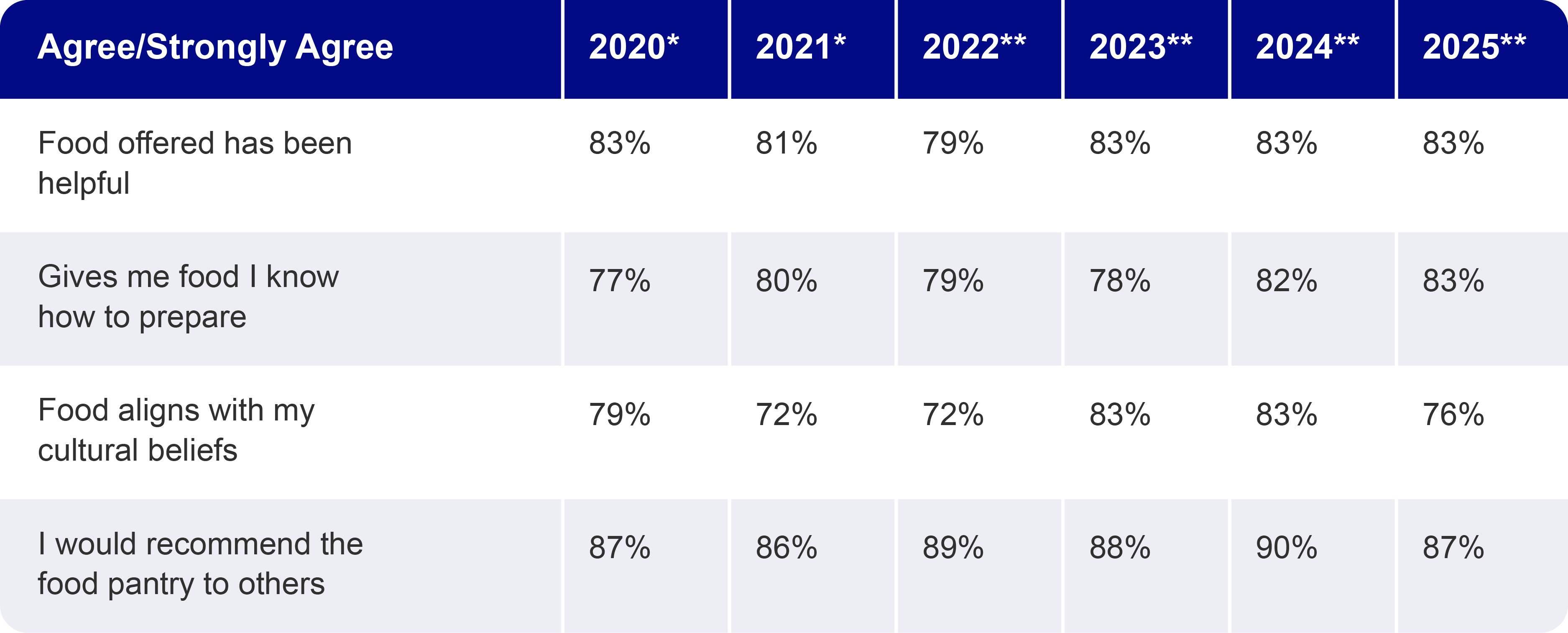
Charitable Food and Nutrition Assistance Program Experience Among Massachusetts Households with Food Insecurity
.png)
**2022–2025: measured using the 18-item USDA Household Food Security Survey Module (household-level)
**2022–2025: measured using the 18-item USDA Household Food Security Survey Module (household-level)
Even with concerns, these charitable food and nutrition assistance programs are still widely used. When asked what would make households with food insecurity not accessing these programs more willing to use them, they most often mentioned:
- Grocery gift cards
- Food delivery
- Online ordering
- Curbside pick-up
74% of households experiencing food insecurity were accessing at least one food and nutrition assistance program (including SNAP, WIC, charitable food and nutrition programs, or nutrition support through MassHealth).
Supplemental Nutrition Assistance Program (SNAP)
Over the last six years, our survey data has shown that participation in SNAP has remained consistent among households experiencing food insecurity. However, the Department of Transitional Assistance (DTA) has observed a recent decline in the number of households served monthly, suggesting potential barriers to access or retention and the recent policy and eligibility changes.
SNAP is highly utilized and effective among those who access it, but fewer households may be accessing it month-to-month, which is an important signal to watch.
- Our data shows that 82% of eligible households experiencing food insecurity used SNAP within the past year.
- 92% of recipients with food insecurity said that SNAP benefits were helpful for their household.
- 78% of households received less than $300 per month in SNAP benefits, and for more than half (57%), this was not enough to cover their monthly food budget.
- Many non-SNAP participants who were likely eligible shared concerns about stigma and self-reliance: 70% of households experiencing food insecurity not using SNAP did not use SNAP because they wanted to support themselves instead.
SNAP Use Among Massachusetts Households with Food Insecurity
.png)
**2022–2025: measured using the 18-item USDA Household Food Security Survey Module (household-level)
SNAP Experience Among Massachusetts Households with Food Insecurity
.png)
Child Food and Nutrition Assistance Programs: School Meals and WIC
Participation in school and summer meal programs among households with children experiencing food insecurity has nearly tripled since 2019, reaching 80% in 2025.1 This steady growth reflects the expanding role these programs play in helping families meet children’s food needs.
Families shared on the survey that they are deeply appreciative of free school meals, describing them as a “lifeline” that reduces stress and ensures children are fed, especially those facing financial hardship.
WIC and School/Summer Meals Participation Among Households with Children and Food Insecurity

**2022–2025: measured using the 18-item USDA Household Food Security Survey Module (household-level)
† Restricted to households with children under age 5 experiencing food insecurity
‡ Calculated differently than in previous years due to improved eligibility questions: WIC used in last year / (WIC used in last year + self-reported as WIC-eligible)
♦ Restricted to households with children under age 18 experiencing food insecurity
♦ ♦ As of 2024, denominator only includes families between the ages of 5–17. Previously all families with children under 18 responded to this question.